
What this page is for
This is an evidence page—not a collection of sensational headlines.
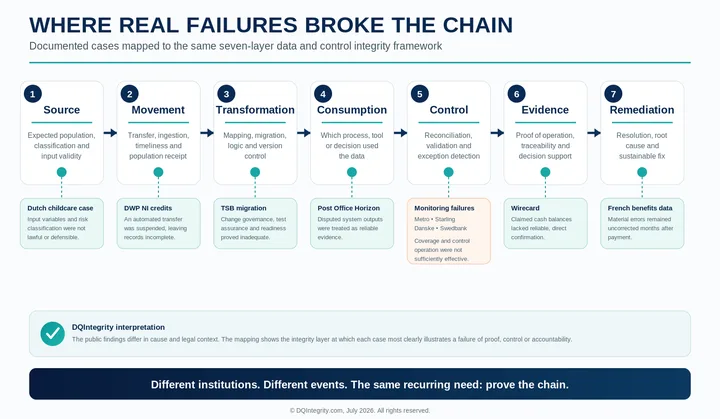
Its purpose is to show a recurring pattern: material harm develops when institutions cannot prove the integrity of populations, transformations, controls, evidence or remediation. The specific legal findings differ, but the control lesson is consistent—confidence must be supported by evidence.
Selected primary-source cases
Metro Bank — £16.7m
The FCA said Metro Bank failed to adequately monitor more than 60 million transactions, worth over £51 billion, for money-laundering risk.
Why it matters: control effectiveness depends on whether the relevant population is actually covered—not merely whether a monitoring platform exists.
Official FCA sourceStarling Bank — £29m
The FCA fined Starling for financial-crime failings related to financial-sanctions screening and breaches of a restriction on opening accounts for high-risk customers.
Why it matters: screening effectiveness depends on customer classification, data completeness, control discipline and governance—not only list-matching logic.
Official FCA sourceNationwide — £44m
The FCA found inadequate anti-financial-crime systems and controls, including weaknesses in due-diligence freshness, risk assessment and transaction monitoring.
Why it matters: customer data, risk classification and monitoring sit in one connected control chain.
Official FCA sourceMonzo — £21.1m
The FCA fined Monzo for inadequate anti-financial-crime systems and controls and repeated breaches of a restriction on high-risk account opening.
Why it matters: rapid growth can amplify structural gaps when onboarding, data, screening and governance controls do not mature together.
Official FCA sourceDanske Bank — $2bn+
US authorities described serious AML failures in Danske Bank’s Estonian branch and misleading statements about the effectiveness of controls.
Why it matters: local monitoring, customer data and group oversight must combine into a truthful enterprise risk picture.
Official SEC sourceSwedbank — SEK 4bn
Sweden’s financial supervisor found major deficiencies in the bank’s work to combat money laundering in its Baltic operations.
Why it matters: information, governance and controls must operate coherently across local entities and group oversight.
Official supervisory sourceDWP — Universal Credit NI credits
The NAO reported that automatic transfer of Universal Credit National Insurance credits to HMRC had been suspended, leaving records requiring correction.
Why it matters: a quiet inter-system handoff failure can create long-lived gaps in individual records without an obvious outage.
Official NAO reportCNAF — €9.4bn uncorrected errors
France’s Cour des comptes declined to certify the family-branch accounts for 2024 and reported €9.4 billion of errors that remained uncorrected nine months after payment.
Why it matters: detection without timely correction, ownership and evidence is not an effective control environment.
Official Cour des comptes sourceWirecard — €1.9bn
ESMA’s report recorded that €1.9 billion of claimed escrow cash did not exist and examined weaknesses surrounding financial reporting supervision and enforcement.
Why it matters: high-consequence balances require direct, independent evidence and reconciliation to authoritative sources.
Official ESMA reportPost Office Horizon
Inquiry and court materials documented software defects, disputed accounting data and failures in the way system-generated evidence was understood and used.
Why it matters: decision-critical system output must be challengeable, traceable and supported by a truthful account of known limitations.
Official Inquiry report
Download the extended evidence brief
Company-email access to the sourced PDF, fuller case summaries and practical questions for assessing a decision-critical data journey.