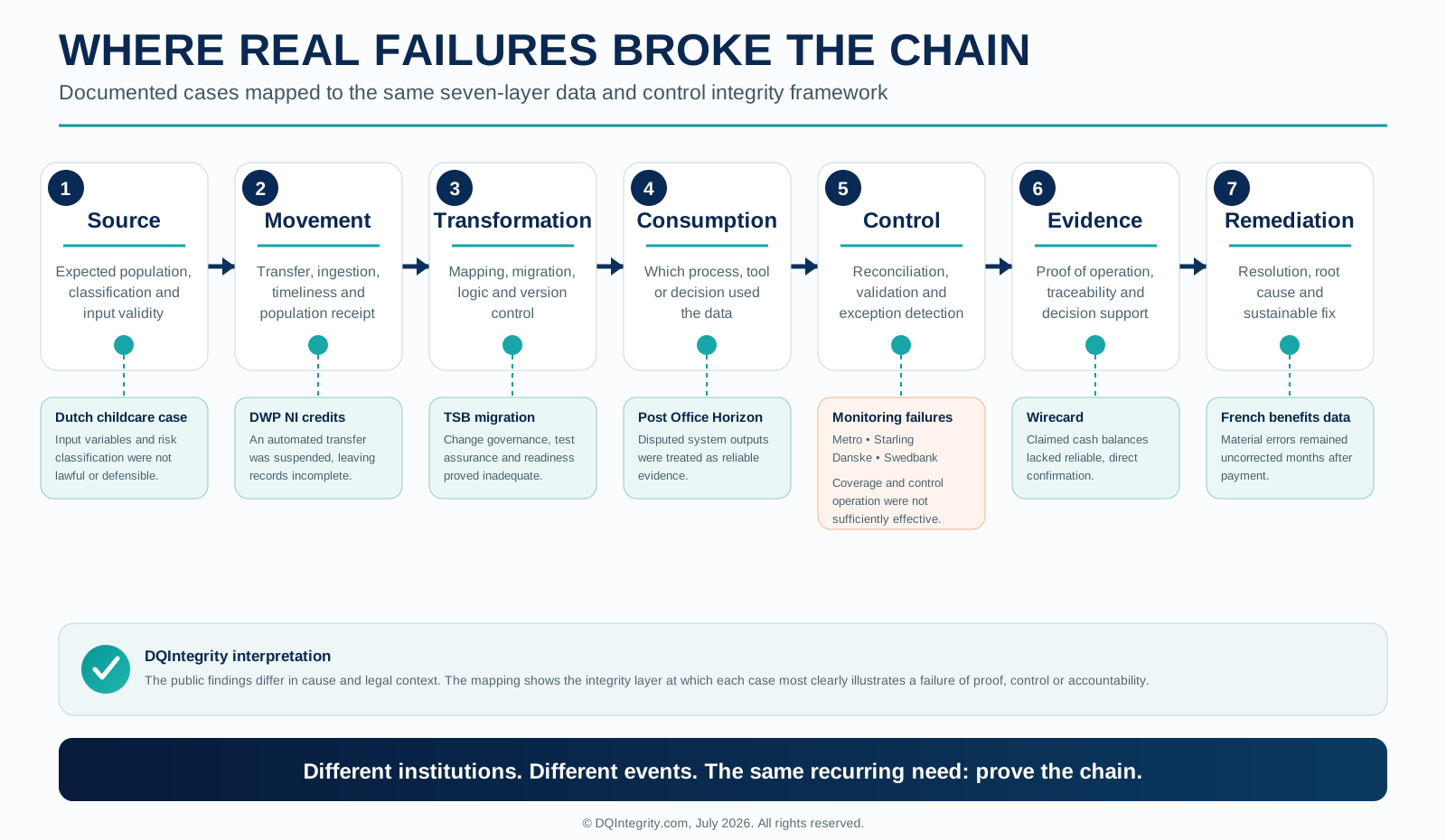
Each summary below is deliberately concise and paraphrased. Follow the primary-source link for the official finding, report or decision.
SourceNetherlands
Dutch childcare-benefits scandal
Official European sources documented discriminatory use of nationality-related data and severe failures of legal protection and redress in fraud-risk processes.
DQIntegrity lens: input selection and classification were not sufficiently lawful, explainable or challengeable before automated risk decisions affected families.
European Parliament study →
MovementUnited Kingdom
DWP Universal Credit NI credits
The UK National Audit Office reported that automated transfer of Universal Credit National Insurance credits to HMRC had been suspended and that records needed correction.
DQIntegrity lens: a critical inter-system feed stopped operating as expected, creating incomplete contribution records unless the break was detected and repaired.
National Audit Office report →
Transformation & changeUnited Kingdom
TSB 2018 IT migration
UK regulators concluded that operational-resilience and governance arrangements around the migration were inadequate, causing widespread disruption after launch.
DQIntegrity lens: this is a change-assurance example rather than proof that data was lost. It illustrates the need to test end-to-end processing, update paths, controls and operating readiness—not only a successful technical migration.
Official FCA source →
Consumption & evidenceUnited Kingdom
Post Office Horizon
The Horizon Inquiry and court judgments documented software defects, disputed branch-accounting data and profound failures in how system evidence was understood and used.
DQIntegrity lens: system outputs were treated as sufficiently reliable for consequential decisions without proportionate challenge of data integrity, known defects and evidential limitations.
Horizon Inquiry report →
ControlUnited Kingdom
Metro Bank monitoring coverage
The FCA said Metro Bank failed to adequately monitor more than 60 million transactions with a value above £51 billion for money-laundering risk.
DQIntegrity lens: the existence of a monitoring platform does not prove that the full relevant transaction population is covered by effective controls.
Official FCA source →
ControlDenmark / Estonia
Danske Bank Estonia
US authorities described serious anti-money-laundering failures in the Estonian branch and misleading statements about the effectiveness of controls.
DQIntegrity lens: monitoring, customer information, oversight and escalation did not create a trustworthy enterprise view of the relevant risk population.
Official SEC source →
ControlSweden / Baltics
Swedbank Baltic AML controls
Sweden’s financial supervisor issued a warning and SEK 4 billion administrative fine after finding major deficiencies in anti-money-laundering work in Baltic subsidiaries.
DQIntegrity lens: local and group-level information, governance and control effectiveness did not provide a sufficiently reliable end-to-end risk picture.
Official Finansinspektionen source →
EvidenceGermany
Wirecard
ESMA’s review recorded that €1.9 billion of claimed escrow cash did not exist and examined supervisory and enforcement weaknesses surrounding the reporting.
DQIntegrity lens: high-consequence balances require independent source evidence, traceability and direct reconciliation—not reliance on internally supplied representations.
Official ESMA report →
RemediationFrance
CNAF family-benefit accounts
France’s Cour des comptes declined to certify the family-branch accounts for 2024 and reported €9.4 billion of errors that remained uncorrected nine months after payment.
DQIntegrity lens: detecting error is not enough. Sustainable control requires correction within the available window, clear ownership and evidence that the affected population has been addressed.
Official Cour des comptes source →